Firewood Seasoning Guide: How Long to Dry Oak, Maple, and Birch
Master the art of drying firewood. Learn seasoning timelines, moisture meter testing techniques, and proper stacking methods to achieve sub-20% moisture content.
Freshly cut firewood can contain up to 50% moisture by weight. Burning wet wood wastes as much as 40% of the tree’s potential heat energy simply boiling off water, creating heavy smoke and dangerous chimney creosote.
Properly seasoned wood contains less than 20% moisture, lights easily, burns clean, and produces intense radiant heat. Here is your definitive guide to drying wood efficiently.
1. Wood Species Drying Timelines
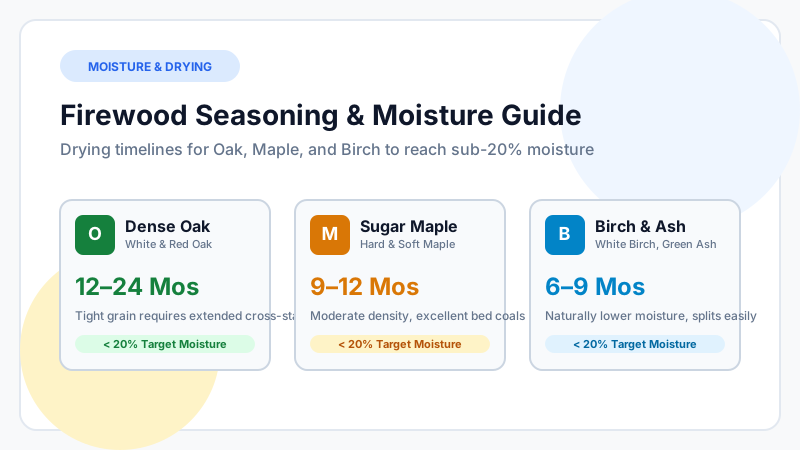
Different wood species lose moisture at dramatically different rates depending on cellular grain structure and resin content:
Oak (White & Red)
- Drying Time: 12 to 24 Months
- Characteristics: Extremely dense, closed vascular pores (tyloses in White Oak).
- Tip: Must be split immediately and stacked in full sun with breezy exposure. Never burn oak with under 12 months of drying.
Sugar Maple & Red Maple
- Drying Time: 9 to 12 Months
- Characteristics: Moderate density, dries evenly throughout the summer months.
- Tip: Protect the top from autumn rains once moisture drops below 25%.
Birch & Ash
- Drying Time: 6 to 9 Months
- Characteristics: White Ash is uniquely low in moisture when alive (approx. 35%), allowing it to dry faster than most hardwoods.
- Tip: Birch bark is waterproof. Split birch promptly to prevent internal rotting.
2. The Golden Rules of Stacking Firewood
To achieve rapid, mold-free seasoning:
- Elevate Off the Ground: Use treated 2x4s, concrete blocks, or wood pallets. Wood in contact with wet earth draws ground moisture.
- Face the Prevailing Winds: Orient stack rows so sunlight and prevailing breezes penetrate through the logs.
- Leave 6 to 12 Inches Between Rows: Never push multiple stacks flush against each other or against exterior walls. Air circulation is the engine of seasoning.
- Cover Only the Top: Leave sides open for maximum airflow. Tarping all the way to the ground traps evaporating moisture.
3. How to Test Moisture with Accuracy
Do not rely on sound or color alone. Use a calibrated two-prong pin moisture meter:
- Select a log from the center of the stack.
- Freshly split the log down the middle.
- Firmly press the meter prongs parallel to the wood grain into the freshly exposed interior face.
- Target Reading: 15% to 19% moisture content.
4. Seasoned Wood Checklist
Before loading your stove or fireplace:
- Weight: Seasoned logs feel significantly lighter than fresh green logs.
- Radial Cracks (Checking): Look for distinctive radial checking cracks along log ends.
- Sound: Two seasoned logs struck together ring with a crisp, hollow “clack” rather than a dull wet thud.
- Bark: Bark pulls away easily or falls off spontaneously.
Plan your winter fuel supply and check stack volume with our free Firewood Cord Calculator.
Need to calculate firewood cords?
Use our free interactive calculator to verify stack volume, cords, and delivery prices.