How Much Does a Cord of Firewood Cost? Average Prices & Delivery Fees
Detailed firewood pricing guide covering full cord, face cord, rick, green, seasoned, and kiln-dried wood costs by region, plus delivery and stacking fees.
Firewood is sold by the cord—a legally defined unit of 128 cubic feet (4 × 4 × 8 ft) of tightly stacked split wood. But the price you actually pay depends on the species, seasoning level, your geographic region, and whether the dealer delivers and stacks for you.
This guide breaks down every cost variable so you can budget accurately and avoid overpaying.
Average Cost of a Full Cord of Firewood
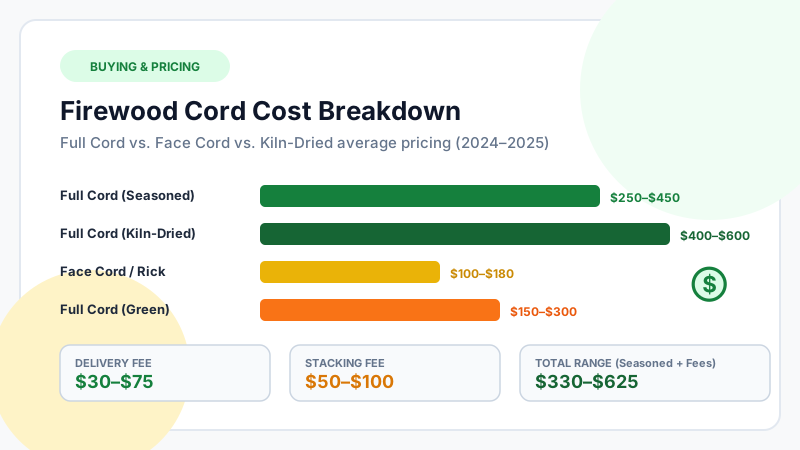
Across the United States and Canada, a full cord of seasoned hardwood typically ranges from $250 to $450, with the final price driven by species, moisture content, and local supply.
Pricing by Seasoning Level
| Seasoning Type | Moisture Content | Price Range (Full Cord) | Best For |
|---|---|---|---|
| Green (Unseasoned) | 35%–50% | $150–$300 | Buyers who can season wood 6–12 months |
| Seasoned (Air-Dried) | 15%–20% | $250–$450 | Immediate burning, most common purchase |
| Kiln-Dried | 6%–12% | $400–$600 | Premium instant-burn, lowest creosote risk |
Key takeaway: Green wood is cheapest upfront but requires months of drying time. Kiln-dried wood costs nearly double but is ready to burn immediately with the highest BTU efficiency and lowest chimney creosote deposits.
Use our Full Cord Calculator to estimate total volume and costs for any stack dimensions.
Face Cord and Rick Pricing
A face cord (also called a rick in the Midwest and Southern US) is a single row of wood 4 feet high × 8 feet long, with depth equal to the log length—most commonly 16 inches.
At 16-inch log length, one face cord equals approximately 42.67 cubic feet, which is exactly one-third of a full cord.
| Unit | Approximate Volume | Typical Price |
|---|---|---|
| Face Cord (16″ logs) | ~42.67 ft³ (⅓ cord) | $100–$180 |
| Face Cord (12″ logs) | ~32 ft³ (¼ cord) | $75–$140 |
| Face Cord (24″ logs) | ~64 ft³ (½ cord) | $150–$250 |
Always confirm the exact log length before agreeing on a face cord price—shorter logs mean you’re getting significantly less wood per face cord.
Calculate exact face cord volume and per-cord cost with our Face Cord Calculator.
Regional Pricing Across North America
Firewood prices vary substantially by region due to differences in timber supply, labor costs, heating demand, and transportation distances:
| Region | Seasoned Hardwood (Full Cord) | Common Species | Notes |
|---|---|---|---|
| Northeast (NY, PA, New England) | $350–$500 | Oak, Maple, Birch | High demand; long winters drive prices up |
| Midwest (WI, MN, MI, OH) | $200–$350 | Oak, Ash, Elm | Abundant timber supply, lower average costs |
| Southeast (GA, TN, Carolinas) | $200–$300 | Hickory, Oak, Pine | Shorter heating season, mixed hardwood/softwood |
| Pacific Northwest (OR, WA) | $250–$400 | Douglas Fir, Alder, Maple | Softwoods prevalent; hardwood commands premium |
| Mountain West (CO, MT, ID) | $300–$450 | Lodgepole Pine, Aspen, Fir | High altitude heating demand, limited hardwood |
| Canada (Ontario / Quebec) | CAD $300–$500 | Sugar Maple, Birch, Ash | Measured in cords or stères (1 stère ≈ 0.276 cords) |
Why Prices Swing
- Species density: A cord of Shagbark Hickory (27.7 MBTU) produces nearly double the heat of Eastern White Pine (14.3 MBTU), so premium hardwoods command higher prices.
- Seasonal timing: Ordering in spring or early summer (April–June) is typically 15%–25% cheaper than emergency fall purchases.
- Quantity discounts: Many dealers offer $25–$75 off per cord when you buy 3 or more cords at once.
Delivery and Stacking Fees
Most firewood dealers charge separately for delivery and stacking on top of the wood cost:
Delivery Fees
| Distance | Typical Fee |
|---|---|
| Local (under 15 miles) | $30–$50 |
| Standard (15–30 miles) | $50–$75 |
| Extended (30+ miles) | $75–$125+ |
Some sellers include “free delivery” within a local radius but bake the cost into higher per-cord pricing. Always compare the total landed cost (wood + delivery + stacking) between dealers.
Stacking Fees
Professional stacking typically costs $50–$100 per cord. It’s worth it if you lack the physical ability or time, but most buyers save money by stacking wood themselves using proper seasoning techniques.
How to Verify You Got a Full Cord
The National Institute of Standards and Technology (NIST) Handbook 130 requires that firewood sold by the cord must meet the legal definition of 128 cubic feet. Here’s how to verify:
- Measure the stack: Length × Width (log depth) × Height in feet.
- Divide by 128: The result is your cord count.
- Check log length consistency: All logs in a cord should be the same approximate length (typically 16″ for face cords or full 48″ for a true 4-ft-deep cord).
- Use a moisture meter: Insert a calibrated pin-type meter into a freshly split log face. Seasoned wood should read under 20% moisture content.
If a truckload seems short, measure it before the driver leaves. A standard 8-foot pickup bed thrown full of loose wood holds only about ⅓ of a cord—far less than many buyers expect.
Verify any stack with our Loose Cord Calculator to convert thrown or tumbled loads into true stacked cord equivalents.
Money-Saving Tips When Buying Firewood
- Buy in spring or early summer when demand is lowest and dealers are clearing winter inventory.
- Purchase green wood and season it yourself for 6–12 months to save 30%–40% versus seasoned prices.
- Split and stack your own wood to avoid $50–$100 stacking fees per cord.
- Buy in bulk: 3+ cords often qualifies for volume discounts of $25–$75 per cord.
- Source from local arborists or tree services who sometimes offer fresh-cut hardwood rounds at low cost or free if you haul it yourself.
- Inspect before paying: Measure the stack, check moisture, and confirm species. Reputable dealers welcome verification.
What to Look for on a Firewood Receipt
Under NIST Handbook 130 and many state weights-and-measures laws, a legal firewood receipt must include:
- Seller’s name and address
- Buyer’s name and delivery address
- Quantity in cords (not vague terms like “truckload” or “rack”)
- Species of wood (or “mixed hardwood”)
- Seasoning condition (green, seasoned, or kiln-dried)
- Total price including delivery and stacking fees
If a seller refuses to provide a proper receipt or uses non-standard volume terms, consider it a red flag. Report suspected short-cord fraud to your state’s Department of Weights and Measures.
Calculate your exact firewood needs and budget with our free Firewood Cord Calculator today.
Need to calculate firewood cords?
Use our free interactive calculator to verify stack volume, cords, and delivery prices.