How Many Cords of Firewood Do I Need for Winter? Home Size & BTU Chart
Calculate how many cords of firewood you need for winter heating based on home square footage, climate zone, stove efficiency, and wood species BTU output.
Planning your winter firewood supply is one of the most important decisions for wood-heat homeowners. Buy too little and you scramble for overpriced emergency deliveries in January. Buy too much and you waste money on wood that may deteriorate before next season.
This comprehensive guide helps you calculate the exact number of cords you need based on your home’s square footage, climate zone, heating appliance efficiency, and preferred wood species.
Winter Firewood Requirements by Home Size and Climate Zone
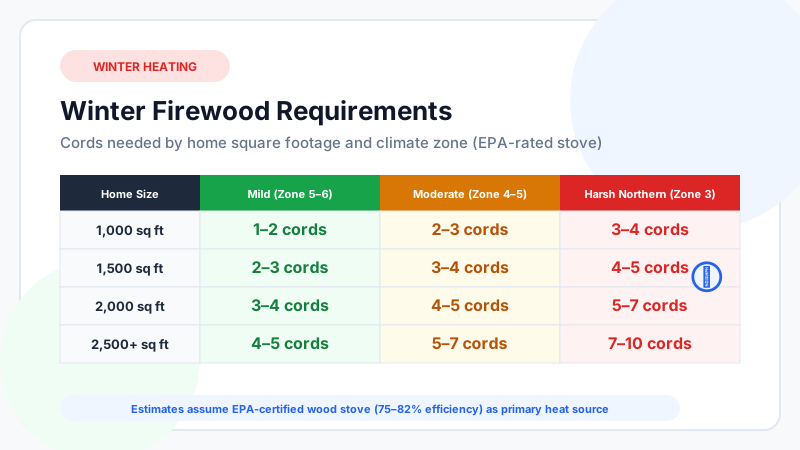
The chart below estimates the total cords of seasoned hardwood needed to heat a home primarily with wood through an entire winter season, assuming an EPA-certified wood stove operating at 75%–82% efficiency:
| Home Size | Mild Winter (Zone 5–6) | Moderate Winter (Zone 4–5) | Harsh Northern (Zone 3) |
|---|---|---|---|
| 1,000 sq ft | 1–2 cords | 2–3 cords | 3–4 cords |
| 1,500 sq ft | 2–3 cords | 3–4 cords | 4–5 cords |
| 2,000 sq ft | 3–4 cords | 4–5 cords | 5–7 cords |
| 2,500+ sq ft | 4–5 cords | 5–7 cords | 7–10 cords |
Understanding USDA Hardiness Climate Zones
- Zone 3 (Harsh Northern): Minnesota, Wisconsin, Vermont, northern Maine, Montana, Upstate New York, and most of Canada. Heating season runs October through April (6–7 months), with sustained temperatures below 0°F.
- Zone 4–5 (Moderate): Southern New England, Mid-Atlantic, Midwest (Ohio, Indiana, Iowa), and Pacific Northwest inland areas. Heating season spans November through March (4–5 months).
- Zone 5–6 (Mild): Southern Appalachians, mid-South (Tennessee, Kentucky), and coastal Pacific Northwest. Heating season is typically December through February (2–3 months) with occasional supplemental heating.
Calculate your exact stack volume and cord count with our Firewood Cord Calculator.
Heating Appliance Efficiency: The Biggest Variable
The type of heating appliance you use has the single largest impact on how many cords you burn per winter. Modern EPA-certified stoves extract 5 to 8 times more usable heat from the same amount of wood compared to an open fireplace.
Appliance Efficiency Comparison
| Heating Appliance | Combustion Efficiency | Cords Needed (2,000 sq ft, Zone 4) |
|---|---|---|
| Open masonry fireplace | 10%–15% | 12–20+ cords |
| Fireplace insert (older model) | 40%–55% | 6–9 cords |
| EPA-certified catalytic stove | 75%–82% | 4–5 cords |
| EPA-certified non-catalytic stove | 70%–78% | 4–6 cords |
| Outdoor wood boiler (EPA Phase 2) | 70%–80% | 5–7 cords |
| Masonry heater (Finnish / Russian) | 80%–90% | 3–4 cords |
Critical insight: An open fireplace is essentially a heat leak—it draws heated indoor air up the chimney while radiating only 10%–15% of the fire’s energy into the room. If you rely on an open fireplace, expect to burn 3 to 5 times more wood than a modern EPA-certified stove for the same heating result.
The U.S. Environmental Protection Agency (EPA) maintains a certified wood stove database listing approved models with their tested efficiency and emissions ratings.
BTU Output by Wood Species
Not all cords are equal in heating value. Dense hardwoods deliver substantially more heat per cord than softwoods because they contain more combustible cellulose and lignin per cubic foot of stacked wood.
Heat Output Comparison (Seasoned, ~20% Moisture)
| Species | Million BTUs / Cord | Weight (Seasoned) | Burn Characteristics |
|---|---|---|---|
| Shagbark Hickory | 27.7 MBTU | ~4,200 lbs | Longest burn time, excellent coaling |
| White Oak | 26.4 MBTU | ~3,900 lbs | Superior coals, steady overnight heat |
| Sugar Maple | 24.0 MBTU | ~3,600 lbs | Clean burn, easy to split |
| White Ash | 23.6 MBTU | ~3,450 lbs | Low moisture, seasons quickly |
| Yellow Birch | 22.5 MBTU | ~3,400 lbs | Pleasant aroma, good heat |
| Red Maple | 20.0 MBTU | ~3,000 lbs | Moderate heat, widely available |
| Douglas Fir | 20.7 MBTU | ~2,900 lbs | Best softwood, quick-starting |
| Eastern White Pine | 14.3 MBTU | ~2,100 lbs | Kindling and shoulder-season only |
What This Means for Your Winter Supply
If you switch from burning White Oak (26.4 MBTU/cord) to Eastern White Pine (14.3 MBTU/cord), you need nearly twice as many cords to produce the same total heat output. Always factor species BTU ratings into your purchase quantity.
Check weight per cord for any species with our Cord Weight Calculator.
How to Calculate Your Exact Winter Heating Needs
Use this step-by-step formula to estimate your personal cord requirement:
Step 1: Estimate Your Seasonal Heating Demand
Heating Demand (BTU) = Home sq ft × BTU per sq ft per heating degree day × Heating Degree Days (HDD)For a simplified calculation, use these regional benchmarks:
| Climate Zone | Approx. Total Season BTUs (2,000 sq ft home) |
|---|---|
| Mild (Zone 5–6) | 60–80 million BTU |
| Moderate (Zone 4–5) | 80–120 million BTU |
| Harsh (Zone 3) | 120–180 million BTU |
Step 2: Factor in Appliance Efficiency
Gross BTU Needed = Heating Demand ÷ Appliance EfficiencyExample: 100 million BTU demand ÷ 0.78 (EPA non-catalytic stove) = 128 million gross BTU from wood.
Step 3: Divide by Species BTU Rating
Cords Needed = Gross BTU Needed ÷ BTU per CordExample: 128 million BTU ÷ 24.0 MBTU (Sugar Maple) = 5.3 cords of Sugar Maple.
Convert your cord estimate into cubic feet and stack dimensions with our Cord to Cubic Feet Converter.
Chimney Safety and Creosote Prevention
Burning wood—even properly seasoned hardwood—produces some creosote, a tar-like residue that accumulates inside chimney flues. Excessive creosote buildup is the leading cause of chimney fires in North America.
NFPA and CSIA Safety Guidelines
The National Fire Protection Association (NFPA) and the Chimney Safety Institute of America (CSIA) recommend:
- Annual chimney inspection: Have a CSIA-certified chimney sweep inspect your chimney and flue at least once per year, ideally before the heating season begins.
- Professional cleaning when needed: If creosote buildup exceeds ⅛ inch (3 mm) thickness anywhere in the flue, schedule a professional sweep before continuing to burn.
- Burn only seasoned wood: Wood with moisture content below 20% produces dramatically less creosote than green or wet wood. Use a pin-type moisture meter to verify.
- Maintain hot, clean burns: Smoldering fires at low air settings produce the most creosote. Reload your stove with 2–3 splits at a time and open the air damper fully for the first 15–20 minutes to establish a hot, clean secondary burn.
- Install a chimney cap: Prevents rain, snow, animals, and downdrafts from entering the flue. NFPA 211 recommends spark-arresting chimney caps for all wood-burning installations.
Woodlot Storage Best Practices
Proper storage and seasoning directly affect how many cords you’ll actually burn, since wet wood wastes 30%–40% of its heat energy evaporating moisture.
Arborist-Recommended Storage Tips
- Split immediately after cutting: Splitting exposes the interior wood grain to air and sunlight, accelerating drying by 40%–60% compared to leaving rounds intact.
- Stack in a sunny, breezy location: Orient rows to catch prevailing winds. South-facing exposures dry fastest.
- Elevate off the ground: Use treated lumber, concrete blocks, or pallets to prevent ground moisture wicking into bottom logs.
- Leave 6–12 inches between rows: Never stack rows directly against each other or against exterior walls—air circulation is the engine of seasoning.
- Cover only the top: Drape a tarp or install a shed roof over the stack but leave all four sides open. Wrapping wood in plastic traps evaporated moisture and encourages mold growth.
- Rotate your stock: Burn the oldest, driest wood first (first in, first out). Season next year’s supply in a separate stack labeled with the split date.
Planning Summary: Quick-Reference Chart
| Your Situation | Estimated Winter Cords |
|---|---|
| Small cabin (800–1,000 sq ft), mild winter, EPA stove | 1–2 cords |
| Average home (1,500 sq ft), moderate winter, EPA stove | 3–4 cords |
| Large home (2,000+ sq ft), harsh winter, EPA stove | 5–7 cords |
| Any home, open fireplace only | Multiply EPA estimate × 4–5 |
| Supplemental heating (furnace primary) | 1–2 cords regardless of size |
Start planning early. Order your winter supply by late spring to get the best prices and ensure adequate seasoning time. Use our free Firewood Cord Calculator and Cord Weight Calculator to calculate exact volumes, stack dimensions, and delivery weights before you buy.
Need to calculate firewood cords?
Use our free interactive calculator to verify stack volume, cords, and delivery prices.