How to Measure a True Cord vs. Face Cord of Firewood
Learn the legal difference between a standard full cord (128 cubic feet) and a face cord or rick. Avoid common firewood purchasing scams with our measurement formulas.
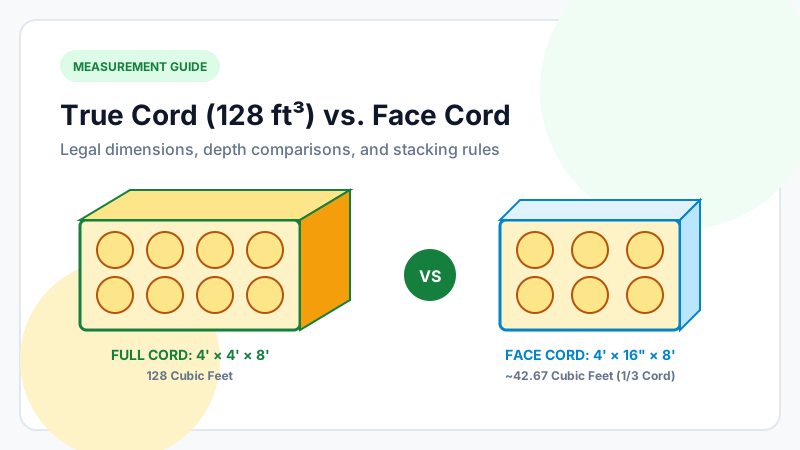
When buying firewood for your wood stove, fireplace, or outdoor boiler, few terms create more confusion than the difference between a true standard cord and a face cord (often referred to regionally as a rick or stove cord).
Understanding these measurements is critical—not only for fair pricing, but also to ensure you have enough fuel to heat your home throughout the coldest winter months.
1. What Is a Legal Standard Cord?
In weights and measures jurisdictions across North America, a standard full cord is defined by law as 128 cubic feet of tightly stacked split wood, including bark and necessary air space.
The classic dimensions of a full cord stack are:
Gross Stack Volume = 4 ft (height) × 4 ft (depth) × 8 ft (length) = 128 ft³Key Rules of a Standard Cord:
- Depth: 4 feet (48 inches)
- Height: 4 feet (48 inches)
- Length: 8 feet (96 inches)
- Metric Volume: 3.62 cubic meters (m³) or stères.
Although the gross stack volume is 128 cubic feet (ft³), the actual volume of solid wood typically ranges between 75 and 90 ft³ (58% to 70% solid density), with the remainder being the natural airspace required between split logs.
2. What Is a Face Cord or Rick?
A face cord is NOT a legally recognized commercial unit of sale in many states and provinces, yet it remains the most common retail unit sold by local suppliers.
A face cord refers to a single row of wood that is 4 feet high and 8 feet long, but with a depth equal only to the length of the cut logs—most commonly 16 inches (1.33 feet).
Calculating Face Cord Volume:
Face Cord (16" log depth) = 4 ft × 1.33 ft × 8 ft ≈ 42.67 ft³Because 42.67 cubic feet is exactly one-third of 128 cubic feet, three face cords of 16-inch wood equal one full cord:
3 Face Cords (at 16 inches) = 3 × 42.67 ft³ = 128 ft³ (1 Full Cord)What if Logs Are Cut to 12 or 24 Inches?
- 12-inch logs: A face cord is
4 × 1.0 × 8 = 32 ft³(Requires 4 face cords per full cord). - 16-inch logs: A face cord is
4 × 1.33 × 8 = 42.67 ft³(Requires 3 face cords per full cord). - 24-inch logs: A face cord is
4 × 2.0 × 8 = 64 ft³(Requires 2 face cords per full cord).
Always ask your supplier the exact log length before agreeing on a face cord price!
3. How to Calculate Cords in Irregular Stacks
If your wood is stacked against a shed, between fence posts, or on uneven ground, you can calculate the exact cord volume using this simple formula:
Cords = (Length in feet × Width in feet × Height in feet) ÷ 128Step-by-Step Example:
- Measure the stack length: 14 feet
- Measure the log length (width): 16 inches (1.33 ft)
- Measure the average stack height: 5 feet
- Calculate gross volume:
14 × 1.33 × 5 = 93.1 ft³ - Divide by 128:
93.1 ÷ 128 = 0.727 Cords
You can run these exact measurements through our interactive Firewood Cord Calculator for instant results, metric conversions, and fuel cost estimates.
4. Top 3 Firewood Buying Pitfalls to Avoid
- Thrown “Truckload” Cords: A standard 8-foot pickup truck bed thrown full of wood only contains roughly 1/3 of a full cord (around 45 ft³). It must be stacked tightly to reach half a cord.
- “Tossed Cords”: Loose thrown wood occupies about 180 cubic feet (ft³) to yield 128 cubic feet of neatly stacked firewood.
- Green vs. Seasoned Wood: Green wood contains over 45% moisture, making it much heavier to transport and giving off only half the usable heat of seasoned firewood.
Need to calculate firewood cords?
Use our free interactive calculator to verify stack volume, cords, and delivery prices.